AI Cognitive Externalization: Why Outsourcing Thought Cannot Last

Published
Modified
AI can improve assignments while weakening independent learning
Outsourcing judgment differs from using AI as support
Accountability eventually returns to human decision-makers
In a county in central China, nearly 27,000 middle and high school students spent six months working on their assignments with the help of generative AI tools. The time spent on each assignment dropped from 64 to 45 minutes and assignment scores went up by 18 percent. Over the same period, grades in closed-book tests dropped by 20 percent. The decline didn't happen immediately; it gradually grew as students became more proficient in using the tools and as more material was taught after they were adopted, meaning that short-term studies likely underestimate the true cost. The finding sounds like a school, but its logic doesn't stop in the classroom. Whenever a thought process is transferred entirely to a system that produces a ready-made answer, one must sooner or later answer for the result and at that moment what has really been learned is revealed.
Better AI-Assisted Performance Does Not Prove Learning
Before adoption, students who scored higher on assignments tended to score higher on tests as well; the relationship was almost self-evident. Among AI users, this relationship was reversed. The faster and more flawlessly one completed a task, the more likely they were to perform worse on the exam they followed. For the entrance exams, where the damage took about two years to reach its full size, the drop reached 24 percent for the high school entrance exam and 18 percent for the university entrance exam. The loss was not equally shared between classes or students. In social subjects, it reached 27 percent, in STEM subjects, 22 percent, in English 17 percent and it was more pronounced among younger people, boys and high-performing students, a group that would normally be expected to have the least to lose.
A minority of students, about one in five AI users, continued to spend about the same amount of time on assignments as non-users. This group scored similarly on the tests as those who did not use the tool at all, even though their assignment grades were also higher. The difference lies not in the tool itself, but in what exactly is delegated to it.
Borrowing Thought or Outsourcing It?
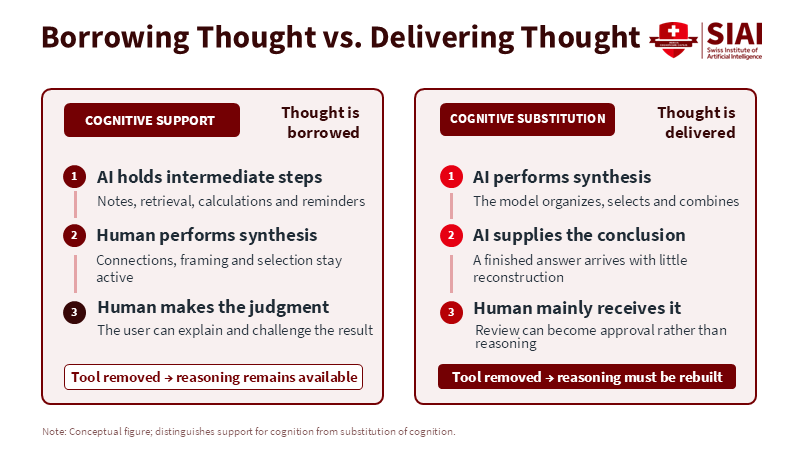
The distinction between two different uses of a tool is not new, but it is rarely applied accurately to artificial intelligence. A notebook, a calculator or a diagram can store intermediate steps so that the working memory can be freed up for the next part of the problem. The user is still thinking; he just doesn't have to keep everything in his mind at once. This is thought borrowing. What happens when someone asks a language model to compose an argument, organize an essay or draw a conclusion is something different. An intermediate step is no longer stored; the whole process of synthesis, selection and judgment is transferred. This is a transfer of thinking, not simply cognitive support.
The same distinction inevitably carries over to the workplace. An analyst who asks a tool to point out inconsistencies in a balance sheet is still judging; an analyst who asks the same tool to draft the report's conclusion has transferred the essence of the work elsewhere. The speed and the end result may seem the same in both cases. The ability retained when the tool is missing is not the same.
Responsibility Does Not Transfer to the System
AI does not have legal personality under English law. In the UK, the jurisdiction task force that looked into the issue confirmed in 2026 that responsibility always lies with the people and organizations that design, develop and use a system, not the system itself. The Stanford AI Index for 2026 recorded 362 documented AI incidents in 2025, compared to 233 in 2024, an increase of over 50 percent within a year. The number does not only reflect technical errors of the models.
The model of shared responsibility leaves no room for a real surrender of thought. The end-user is always asked to validate the recommendation, understand the limits of the tool and decide based on both AI insight and human experience. When something goes wrong, no account is sought from the model. It is sought by the human who signed, explicitly or implicitly, the result.
The Limit of AI Cognitive Externalization
If responsibility always returns to a human being, then handing over thought to a system can never be a permanent solution, only a postponement. The moment when the audit comes, an examination, a client asking why, a regulatory body asking for justification, is the moment when one has to reconstruct reasoning that they had never really done. This retrospective reconstruction is slower, more prone to error and less reliable than if the thought had been done in the first place. The finding for students who kept their working time constant shows the way to an alternative, not abstaining from the tool, but retaining the time and effort required by the control. In training, this means supervised working time combined with guidance for productive use of the tool. In an organization it means explicitly defined points where a decision goes through a person with real authority to challenge it, not just sign it.
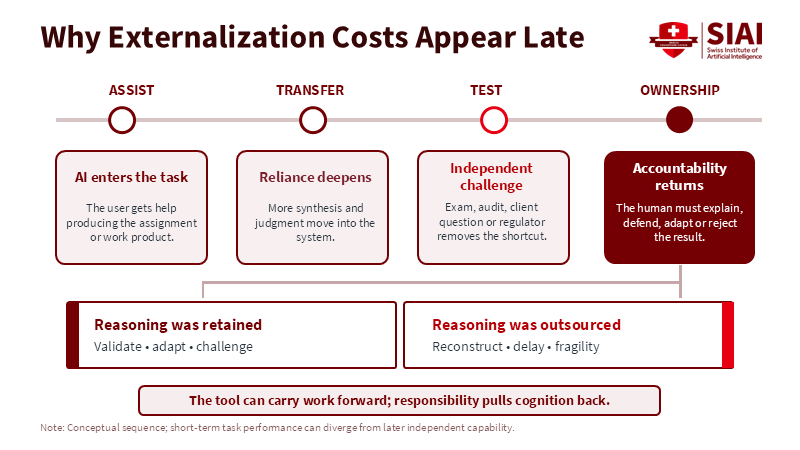
The objection that this cancels productivity gains does not stand up to the evidence itself. The group of students who maintained their working time did not lose the tool's help; they simply did not trade it for control. The same is true for any environment where one ultimately needs to explain, not just present, a result.
The image of students in central China, who completed their assignments faster while their exams quietly deteriorated for months, is not just a warning to schools. It is a description of a mechanism that works everywhere where performance is measured earlier than comprehension is measured. Responsibility, however, does not follow the same timing. It comes later, asks for an account and does not accept as a response that the thought was assigned elsewhere.
This article reflects the analytical judgment of the author and does not constitute policy advice or the official position of any affiliated institution.