The Fragile Knowledge of AI in the Classroom

Published
Modified
Fragile knowledge forms when AI teaching skips real questioning
Bayesian framing explains why AI struggles with exceptions
Paywalled science literature makes AI weakest on scientific questions

In the fall announcements, the Alpha School network of private schools announced an expansion to about fifty campuses across the United States. Twenty-seven of these are new locations, with tuition ranging from forty to seventy-five thousand dollars a year. The company's founder speaks openly about the ambition for the method to reach one billion children, in a country where one in five students is considered chronically absent from school. Most of the teaching is assigned to software that adapts to each individual student. Those who studied the approach, however, identified an issue that goes beyond grading. They called it fragile knowledge, a skill that works flawlessly within the conditions in which it was taught yet collapses as soon as circumstances change.
An Experiment on the Scale of One Billion Children
Alpha School itself does not deny that this is an experiment. The process of training the models is openly compared by the company's managers to the training of autonomous vehicles. There, the system learns from millions of incidents to recognize the exception, the cyclist who sways, the child who pops up on the road. The comparison is useful, because it clearly shows its limit. An autonomous car is trained on traffic data that is finite in kind, no matter how large it is in volume. But learning is not just about recognizing patterns. It involves transferring an idea into a context that has never been seen before, something that no database fully covers.
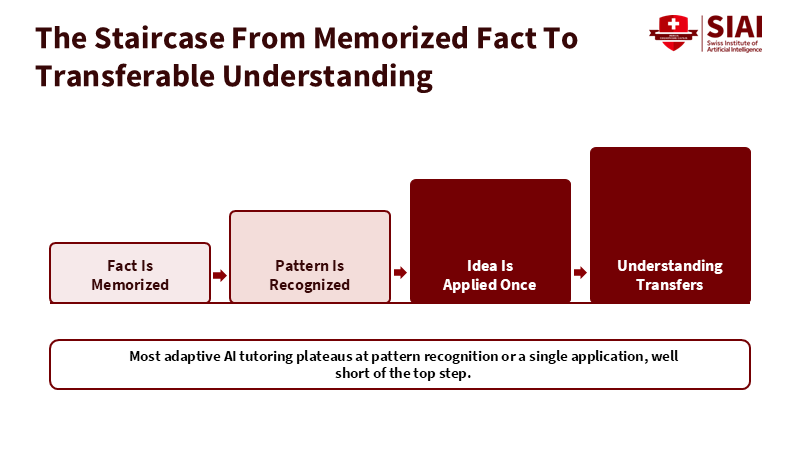
The concern is not just about teaching with software. In a randomized study, one group of students in an introductory physics class used an adaptive digital assistant, while another followed active teaching in the classroom. The first group had twice the average improvement. But the same experiment also highlighted the risk of fragile knowledge, because the assessment was done under the same conditions as teaching. In other words, it was not tested whether what was learned held up outside of that particular form of question. A later review of twenty-eight studies, with almost five thousand elementary and middle school students, found a generally positive effect from intelligent adaptive systems. But this advantage almost disappeared when the systems were compared to simple active learning without any artificial intelligence. The finding deserves attention because it shows that the problem is not necessarily technological.
The Fragile Knowledge Left by Memorization
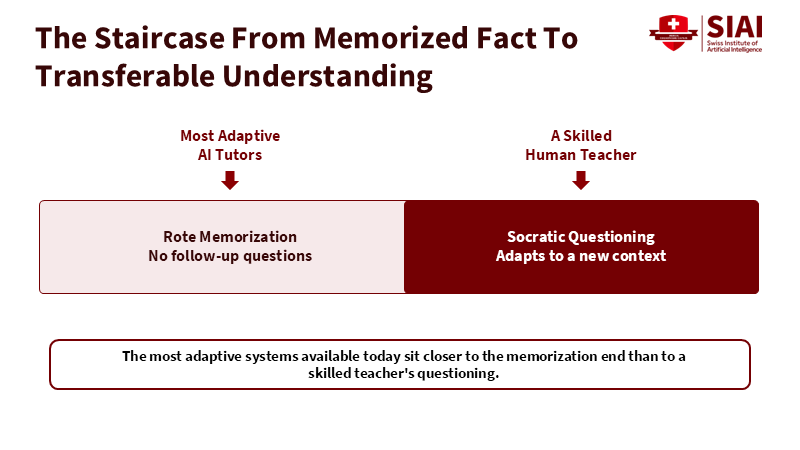
The working hypothesis here is older than artificial intelligence. The value of a good teacher versus a mediocre one, even with exactly the same material, lies in a second layer of learning. This layer is created within the social interaction of teacher and student. In the Western tradition, this interaction often takes a Socratic form, that is, constant questions that force the student to think again and adapt his logic to new conditions. When this process is lacking, the alternative is not emptiness but a different model: memorization without questions. There the material is mastered accurately but without adaptability. The East Asian educational tradition has often been described in these terms, as a system that produces excellent performance in standardized exams, but difficulty in the face of unusual questions.
Today's AI models replicate exactly this second model. They don't do it because they're mimicking a particular educational tradition but because their own architecture works in a similar way. They're trained on a huge amount of question-and-answer pairs, where accuracy is optimized. When a real exception appears, something never seen before in this form, performance breaks. It breaks in a way similar to a student who learned something by heart without ever being asked why. Similarity is not a coincidence. In both cases, the same moment is missing, the one where someone forces the system, human or computational, to justify its answer in other words, in a different context.
What a Bayesian Update Misses with Limited Data
There is also a more technical way to formulate the same problem. What an AI system does when it adapts to a student is, to a large extent, a form of Bayesian updating on limited information. This information is limited to the input and output pair of the specific dataset on which the model was trained. The human mind is described by Harvard research as something that works in part in the same way but is in many ways better. It can identify the exception to a normality that until then seemed constant and revise the entire mental model instead of simply adjusting it gradually. A good teacher does just that when he asks a question that is not in the textbook. This question is designed to test whether understanding survives outside the context in which it was taught.
The concern is not theoretical. It has already been observed that professionals with many years of experience lose some of their ability to think independently when the cognitive load is consistently assigned to AI tools. This phenomenon has recently been documented in a university setting. The same pattern can easily be transferred to a child learning with a digital assistant. Instead of the teacher confirming the understanding with a series of different questions, the child can simply get the correct answer and move on. He will not necessarily be able to apply the same concept elsewhere again to really broaden the scope of his knowledge.
Why Science Breaks AI Models
There is an additional reason why this weakness becomes more pronounced in scientific subjects. Large language models are mainly trained on data that is freely available on the internet. But most of the reliable scientific literature remains locked behind journal subscriptions. An artificial intelligence tool was recently designed by a research organization in New Zealand with an explicit mandate to draw exclusively from peer-reviewed articles. It ended up returning mostly secondary content from blogs and general websites, precisely because reliable literature remained inaccessible. The problem was not a technical error; it was a structural one. The system simply did not have access to the source that would allow it to learn properly.
This explains why trust in such a system should not be uniform. It is more like a scale that changes depending on the field. In areas where correct answers change a bit and where everyday use does not require access to the cutting edge of research, such a tool can perform reliably, at little cost in the event of a failure. In science, however, a slight discrepancy in data or methodology changes the conclusion and the same system breaks much faster. A question in a field where failure is expected yields little compared to the effort it requires. An expert's judgment is still based on sources that the model has simply never encountered. This radically changes how much weight is worth giving to his answer.
The Design Choice Schools and Teachers Face
The argument in favor of models such as that of the Alpha School is not based on the assumption that they outperform the best possible teacher. It is based on the observation that the quality of teaching differs dramatically even within the same school, to an extent that would not be tolerated in other high-responsibility professions. An adaptive system that is simply better than average could thus replace thousands of inadequate teachers and this would indeed be a reversal in the field. But the argument is weakened by the same finding mentioned above: the advantage of artificial intelligence systems over simple active teaching has proven negligible. If this is confirmed on a larger scale, the question is no longer whether it is worth replacing the mediocre teacher but what exactly it is being replaced with.
School administrators and educational technology companies have a specific design question here, not only ethical but also technical. The evaluation of right and wrong answers scales relatively easily. The Socratic moment, the one where one asks again in different words to see if understanding endures, is much more difficult to scale. Perhaps it is also structurally impossible within the same architecture that produces fragile knowledge in the first place. Alpha School is now testing its model in public schools in Houston and Springfield, Massachusetts, with a student population much more heterogeneous than its private sector. The question is no longer whether good teaching can be scaled up. It is whether it can be scaled up without losing exactly the element that made it good.
This article reflects the analytical judgment of the author and does not constitute policy advice or the official position of any affiliated institution.